
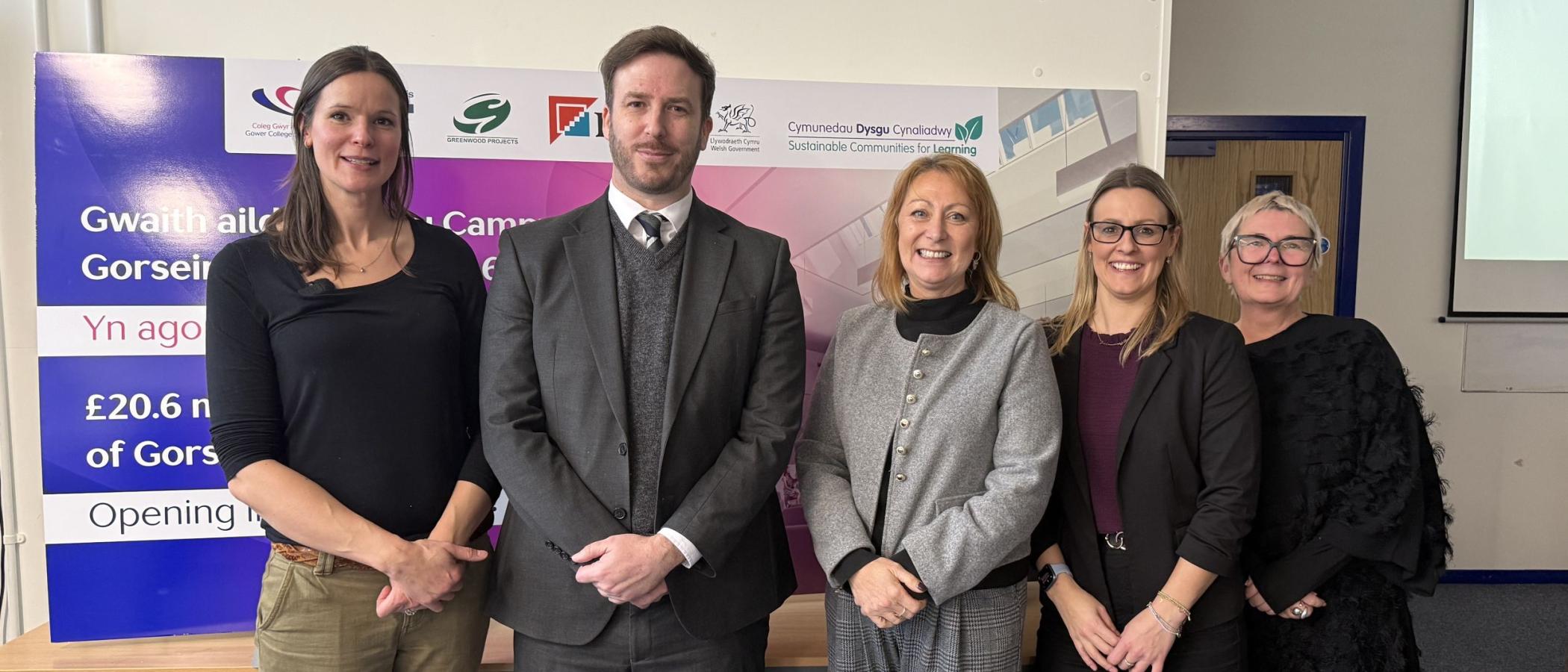
Students from a range of courses including built environment, geography and geology were recently invited to a talk on The Future of Net Zero Carbon (NZC) at the Gorseinon Campus of Gower College Swansea.
Led by Head of Sustainability at McCann and Partners, Virginia Clement, the talk explored what NZC really means in practice. The session also identified the two main components of NZC (operational carbon and embodied carbon) and outlined the key goals driving the transition to a low-carbon built environment.
“We were delighted to welcome Virginia to the College to host this valuable session for our learners who are interested in sustainable design, construction and the future of low-carbon development,” says Principal, Paul Kift.
“The talk was particularly timely as this year will see the official opening of the £20.6m redevelopment of our Gorseinon Campus, which is backed by the Welsh Government’s Sustainable Communities for Learning Programme.”
“This is a project that reflects the College’s ongoing commitment to substantial future investment, elevating the learner experience and supporting the sustainable growth of the College through modern, inspiring facilities and smarter campus infrastructure.”
Virginia has 19 years’ experience in energy and carbon management across the UK and has worked on many high-profile projects such as Fairwater Community Campus in Cardiff and Caerleon Comprehensive School in Newport.
The students were given a fascinating insight into her career journey, from studying BEng (Hons) in Civil Engineering at Bath, through to an Engineering Doctorate (EngD) at Swansea / Gates Foundation, working as a BREEAM Assessor, and detailing how she came to be involved on the Gorseinon redevelopment project.
“After the talk, I hope students will feel confident in explaining the concept of Net Zero Carbon and distinguishing between its two principal components within the context of the built environment,” says Virginia.
“They will be able to demonstrate an understanding of the goals of NZC in relation to climate change mitigation and international decarbonisation targets and will be able to evaluate key strategies for reducing carbon emissions, including fabric-first design approaches, energy efficiency measures, and the integration of renewable energy sources.”